
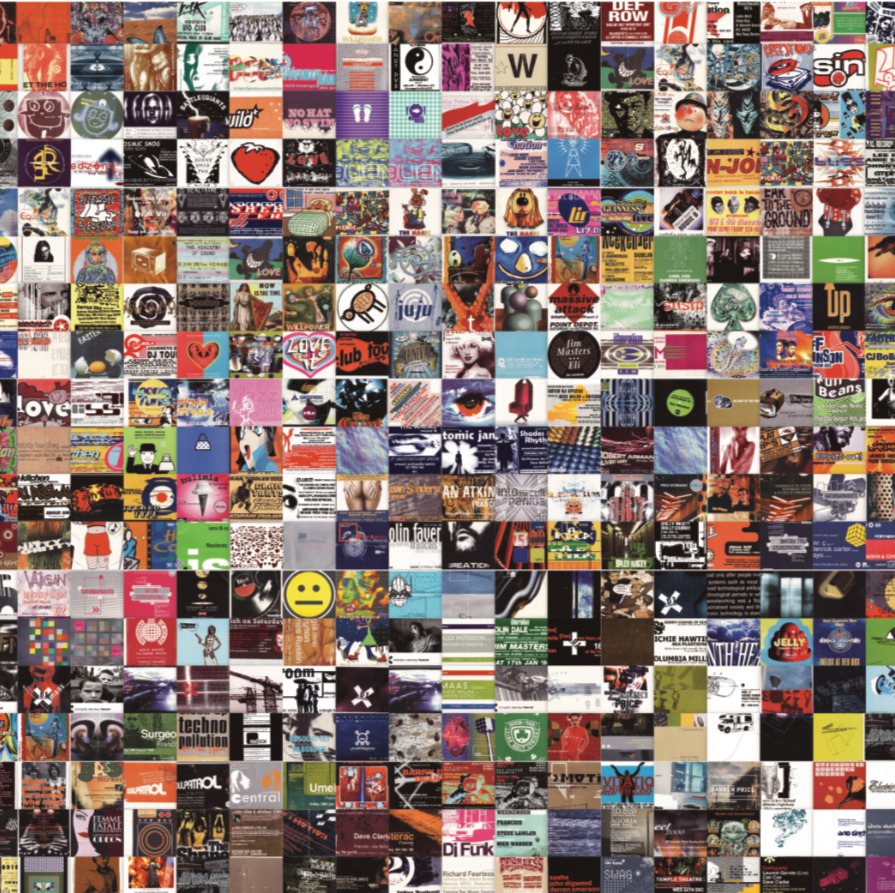

[Click the image above to open in a new tab]
WHERE WE DANCED – DUBLIN CLUBS OF THE 1990s AND 2000s
“Most Irish discos seem to follow the same pattern of fifteen minutes of fast music, ten of slowies, repeated all night. Most sets consist of records from the charts with some golden oldies.”
While these words were published in Dublin fanzine In Touch back in 1977, the nightclub scene a decade later hadn’t changed all that much – barring a few outliers.
Club nights such as Sounds Afrikana and Club Sandino at McGonagles hinted at a burgeoning alternative dance scene, Flikkers (which was sadly destroyed in a fire in 1987) was a early beacon for the gay community, while Sides DC, which opened in 1986, was something of a revelation – a proper nightclub in an otherwise drab metropolis.
As Sides founder John Nolan told RTÉ in May 1987, “We don’t consider ourselves ‘alternative’, as such. We consider ourselves to be doing our own thing. We like to dance, we like to dress in a certain fashion, but to us it’s not alternative. It’s just being ourselves.”
As the 90s dawned, however, there were signs of change – Fun City at The Point in July 1990, which featured Rebel MC, Coldcut, Betty Boo and Candy Flip, was Dublin’s first licensed dance event; former tea dance venue The Olympic Ballroom started running dance gigs in early 1991; and the Mansion House, where the first Dáil Eireann sat back in 1919, kickstarted a societal revolution of a different kind, as it housed a series of dance events.
Or, for those looking for something more underground, there was a nascent free party scene… if you knew where to look. “You’ve got to understand that there’s a dance phenomenon happening at the moment,” Robbie Foy of Voodoo (at McGonagles) told the Irish Independent in October 1989. “People can’t see it on TV or hear it on the radio. […] And going out on Saturday night to find an undisclosed venue is all part of the craic. It adds more to the vibe of the whole thing.”
Dublin Clubbing Finds Its Feet
While 1992 will be remembered as the year Ireland signed up to the Maastricht Treaty, Albert Reynolds was named Taoiseach and Linda Martin achieved the first of a trio of successive victories at the Eurovision Song Contest, it was also a year in which Dublin clubbing arguably came of age.
The year saw the opening of a host of venues – Sides rebranded as Spectrum, Club So and The Rock Garden opened their doors, and the Tivoli Theatre put on its first dance gigs. Arguably the most notorious of them all, however, was The Asylum, which opened on 16 October 1992, and quickly gained a reputation for infamy (or subterranean bliss, depending on your persuasion).
As DJ and producer John Braine put it some years later, The Asylum “bore witness to the first batch of E casualties, burnt out ravers desperately chasing that initial rush, the dawning realisation that nothing this good lasts forever painted across their jaded faces. However, a fresh batch always arrived to fill the void and this new crowd kept the balance in check.”
1992 was also the year that saw an end to the Mansion House raves, despite receiving a ‘thumbs up’ from a selection of TDs that paid a visit to the Dawson Street venue in February. As Workers Party TD Eric Byrne put it, “I have seen nothing here that will cause parents to worry. I feel very envious of these young kids.”
One-off events similarly got bigger and bolder – Heaven On Earth, which took place in May at The Point, promised an ‘abyss of madness’ running until 6am, but was cut short due to authorities, while UK rave crew Spiral Tribe crossed the Irish Sea for an illicit shindig at the Hellfire Club in the Dublin Mountains.
“Disco tarts, drag queens, glamour babes and a veritable zoo of party people…”
It was inevitable that Dublin’s burgeoning underground club scene would soon spawn a sophisticated alternative, and the opening of The Pod in April 1993 by entrepreneur John Reynolds marked a new chapter in the capital’s clubbing chronicles. As club designer Ron McCullough told 909originals, “John was a ‘never say never’ kind of guy… just get in there and make something happen”. Elsewhere, dSide magazine mused at the time that the Longford native could “walk on water”.
For those not prepared to don their glad rags only to be refused entry to The Pod (or ‘Pricks on Door’, as it became colloquially known by some) 1993 also saw several pivotal venues open, including the Temple of Sound, Ri-Rá and The Ormond Multimedia Centre – “possibly the best warehouse venue ever to hit Ireland”, as Tonie Walsh described it some years later.
Key club nights to find their feet that year included JuJu Club the Beat Club and Horny Organ Tribe, which promised “disco tarts, drag queens, glamour babes and a veritable zoo of party people bumping and grinding to an eclectic mix of solid, upfront dance tunes”, according to a press release of the time.
In other words, Dublin clubbing was going mainstream. As Clifford Coonan wrote in The Irish Times in March 1993, “A new era is dawning, as dance culture moves in on the Dublin scene. After years of fiddlers and guitar gurus, get ready for the megablast of booming bass and the dulcet tones of progressive house music.”
Raising The Bar
By the time the mid-90s rolled around, Dublin clubbing had not just reached maturity – it was being talked about as the finest city in Europe in which to go for a bop, supported by an ever-growing list of venues and groundbreaking club nights. As Jim Carroll wrote in the Irish Independent in February 1994, “Two years ago young people didn’t come into Dublin because there was nowhere to go, but now many of its clubs are considered world class. Young Irish people are good at running clubs here or abroad because of one thing: their neck.”
If The Pod set the tempo for upmarket clubbing, U2’s The Kitchen nightclub, which opened on Valentine’s Day 1994 (notwithstanding a one-off opening the previous autumn), sought to combine cosmopolitan cool with a seriously solid soundsystem. Asked as to what sort of clientele the club would expect, Bono told RTÉ, “People who are cool enough to leave me alone. The sort of people you like to hang out with, anyway. There’s no VIP room… hopefully there’ll be special treatment for everybody that wants to queue up and come in.”
The year 1994 also saw the opening of Columbia Mills (in the former Waterfront venue), The Furnace, and the rebranding of the former Sides nightclub under another new identity, Gravity.
As for seminal clubnights, few promoters sought to shake things up as much as Martin Thomas’ Strictly Fish, home to the Strictly Handbag nights at Powers Hotel (later in The Kitchen and Ri-Rá) – as The Irish Times put it, Strictly Handbag was “like being at a wedding reception every Monday night”.
Beating To A Different Rhythm
“While scholars and their bloated hordes of promoters exhume the corpses of dead writers and lament the loss of poetry and lyricism, under the pavement, in the haunted dancehalls that is the clublands, the city beats to a new rhythm.”
dSide summed up the mood of the nightclub scene as Dublin entered the mid-part of the decade – a glance at old club listings from the period shows the sheer wealth of options available all week long, from the newly-opened System, Temple Bar Music Centre, and Mean Fiddler, to established venues such as The Pod, Columbia Mills and Shaft – “the boogie bin for those who can’t stop dancing”, as the Evening Herald put it.
A new-found confidence pervaded the city’s streets – Eamonn Doyle set up D1 Records, promotions vehicle Influx held its first club nights, even previously-rock oriented venues such as the SFX were now swaying to a different beat. Promoters were also daring to be different – 1995 saw the launch of GAG, arguably the city’s first mainstream fetish night, which promised “specialty shaving, kinky boots, salt licks, a wet lounge, lots of ‘toys’ and a nightly slave drive in addition to appropriate disco sounds”.
Ireland was plugged in, and “part of the global village,” as the Sunday Independent put it in July of that year. “Depending on your poison, we’re a rave or rhythm nation.”
A New Clubbing Cognoscenti
“Clubbing in Dublin is finally starting to move away from the mindless, e-addled turbo techno and Macarena fuelled wally disco,” The Irish Times noted in late 1996. “It’s starting to expand its horizons, reflecting a new club cognoscenti which likes to dance, likes to show good taste and likes to have a few brain cells left at the end of the night.”
Entering the second half of the 90s, clubbing in Dublin was riding the crest of a wave, with international brands such as MTV, Cream, Ministry of Sound and others hitting the Irish capital to soak up its hedonistic atmosphere. Was it the clubbing capital of Europe? There was certainly a good case to be made – as dSide put it in late 1996, “Try finding any other European city with a choice of four killer club nights on a Monday, from Miss Candy’s new Kitchen jamboree to the trustworthy Strictly Handbag in Ri-Rá. Sundays? No probs – you’ve got Diskoakimbo and Lost in Music for starters.”
New venues, too, continued to open, as Dublin entered the ‘era of the superclub’. Late 1996 saw the opening of the RedBox – a ‘big room’ sister to John Reynolds’ subterranean Pod, while the Temple Theatre brought cavernous clubbing to the north inner city, in a converted 18th century church.
Few other venues would go on to capture the zeitgeist like the Temple Street venue – as Italian DJ Mauro Picotto would observe some years later, the Temple Theatre was “the right place with the right music at the right time. I don’t think that any other club has been able to replicate that since, not one.”
A Multi-Faceted Experience
With the Celtic Tiger beginning to roar, the signs of a shift in Dublin clubbing arguably began to emerge as 1997 rolled around – both the Temple of Sound and Ormond Multimedia Centre closed their doors that year, while club goers were also becoming more demanding when seeking out their evening entertainment.
As James Matthew of Velure/Mambo told the Evening Herald in April, “People are moving towards the entire multi-media experience more than they ever have. They want to be entertained for their money, and that means giving people choice in what they hear, do and experience. Just standing around or dancing and glaring at complete strangers isn’t fun any more.”
This was also reflected in growing unease about the cost of a night out – “£16 plus booking fee for a night out in Red Box or Temple Theatre on a Saturday night seems a little prohibitive. Could somebody please sort it out?,” as dSide noted in December – and a feeling that Irish licensing laws were holding back clubland from entering the stratosphere. “There is now a positive feeling of a long-term commitment to dance in Ireland and this is something we want to cultivate,” Strictly Fish’s Martin Thomas observed in the Irish Independent.
That said, there was still room for underground entrepreneurship – The Funnel, one of the city’s most fondly-remembered venues, opened in 1997, while free party pioneers Creation held their first outdoor soirée the same year.
Leading Promoters Come To The Fore
There’s no doubt that the Dublin clubber of the latter years of the 90s was spoilt for choice, such was the embarrassment of riches on offer at venues across the city on a typical weekend night.
As Influx’s Paul Davis told 909originals a couple of years back, “We had such an amazing scene in Ireland in the late 90s. There was a renaissance of the techno scene, and breakbeat, drum and bass and hip hop all taking off. Influx did club nights four nights of the week, all full all the time, and most of them featured Irish DJs.”
Legendary club nights continued to etch themselves into the minds of Dublin clubbers – U:Mack’s Phunk City, Bassbin, D1’s Model One, Genius at The Kitchen, Space at Temple Theatre, Powderbubble at The Pod. While the momentum of new openings had slowed – the HQ Hall of Fame (later to be rebranded Spirit) was the only new venue of note to open in 1998 – Dublin clubbing was still a maelstrom of excitement.
The city’s reputation as a sanctuary for repetitive beats saw an ever-increasing tide of international names descend upon the city on a near-weekly basis; as Judge Jules told 909originals, “From the moment you step off the plane into Ireland, you know it’s going to be an incredible one. Ireland has never let me down, from the first time I visited back in the early 90s, right through to the present day. I don’t think Irish clubbers know how lucky they are!”
Changing With The Times
But was Dublin nightlife becoming a victim of its own success? In late 1999, development agency Temple Bar Properties issued a report that indicated that the increasingly loutish behaviour (largely driven by stag and hen parties travelling over from the UK) was putting off an increasing number of tourists from visiting the city centre. “It’s all young people getting sick,” as one bar owner confided to the Los Angeles Times.
Changes to licensing laws were also afoot, with new legislation enabling bars to open later making its way through the Dáil – the subsequent ‘late bar’ culture would end up spelling doom for many nightclubs in the years to follow.
There were also accusations of price gouging as the Millennium approached, with some venues charging as much as £100 for entry on 31 December 1999, while ‘Operation Nightcap’, the Gardaí’s biggest anti-drugs operation in years, led to an uneasy presence in some venues.
That said, 1999 also saw one of the decade’s most euphoric experiences – the inaugural Homelands Ireland, which took place just up the road from Dublin at Mosney Holiday Centre. As Mr Spring told 909originals, “With Homelands, there was this sense that you were there for the ‘happening’. You weren’t just there to see the three or four headline acts. People were wandering around from stage to stage, and everything was awesome. We were ignorant, and we were blissful.”
Clubbing At A Crossroads
Dublin clubbing at the start of a new Millennium found itself at something of a crossroads – while on the one hand, the city was arguably as vibrant as ever before, there was a notable shift away from the underground to a more polished alternative. “Smaller venues and low-key pubs in the city centre seem to be closing down at an alarming rate,” Anna Carey wrote in the Sunday Tribune in February 2000. “Now, the entire place is a vision in shiny chrome and pine.”
Was lethargy setting in? Clubbing Dot Com, a short-lived magazine that arose out of the website of the same name, suggested in November 2001 that Irish clubland had become “lazier and less innovative than five years ago. There are pockets of resistance in every corner of the land, but too many of the bigger clubs are guilty of resting on their laurels for far too long.”
Late-bar licences led to the demise of several popular venues, such as The Kitchen and Mono, while others, such as Spirit, Tivoli and The Gaiety toyed with ‘theatre licences’, a loophole that enabled them to open their doors till well after 4am (at least until the authorities revised the required legislation).
At the same time, Dublin’s entrepreneurial spirit remained strong with nights like Electric City (arguably the best Thursday night club of the past 25 years), Bodytonic’s first outings, Donal Scannell’s 33:45 in Vicar Street and the late Al Keegan’s Acii Disco and McGruders parties. “Everybody would stay in on Saturday nights to keep themselves ready to go to McGruders on the Sunday,” Keegan would later observe. “There was nothing in Dublin like that, it was like something from Ibiza.”
Yes things were changing, but this was part and parcel of the chameleonic history of Dublin nightlife. The analog rhythms that underpin the city’s club scene continue to shift to this day, and will do so long into the future.
Or, as author Irvine Welsh puts it, “I think there’s definitely a a thing about Ireland – I think Scotland has it as well, maybe some parts of the north of England. There’s a sort of mentality there. […] It’s like, ‘I don’t really give a f**k’, I’m having it, it’s my night out’. You’re going to have a good time, whatever happens.
“If you go in with that mentality, you realise that it’s what you bring to the night out that makes it. The artist isn’t completely irrelevant – if you see a great band or a great DJ, you’re going to really appreciate it – but you’re going to have a f**king great night out anyway.”
See you down the front… 🙂
909originals would like to extend a huge THANK YOU to the following for their assistance in putting the Analog Rhythms exhibition together: Bodytonic, The Bernard Shaw, Aoife Nic Canna, Aiden Grennelle, Barry Mullen, Brian McMahon, Christian Boshell, Brian Nolan, Ciaran Nugent, Dean Sherry, David Begley, Francois Pittion, Frank Kearney, Fergus Murphy, Gavin Lyons, James Redmond, John Braine, Jon Hussey, Johnny Moy, Johnny Lennon, Julie-Ann Smith, Laughlin McKee, Lee Gallagher, Liam Dollard, Liz Dunphy, Mark Kavanagh, Martin McCann, Neil Dowling, Paddy Sheridan, Paul Davis, Paul McCarthy, Peter Houlihan, Robert Mateer, Rohan Reilly, Rory Long, Ronan O’Sullivan, Shane O’Shea, Shelley Bartley, Tonie Walsh, Venetia Quick and everyone else that contributed flyers, photos, articles, anecdotes, or their valuable time. You are all AMAZING. 🙂
[Words by Stephen Wynne-Jones. This article was written to accompany the Analog Rhythms exhibition, which took place in The Bernard Shaw, Dublin, in July 2022 and again in July 2023]
SUPPORT ANALOG RHYTHMS: If you like what you see, why not pledge your support below to keep ANALOG RHYTHMS up and running. You can make a one-time donation or a monthly or yearly contribution. 🙂
Make a one-time donation
Make a monthly donation
Make a yearly donation
Choose an amount
Or enter a custom amount
Your contribution is appreciated.
Your contribution is appreciated.
Your contribution is appreciated.
DonateDonate monthlyDonate yearly ANALOG RHYTHMS – A CELEBRATION OF DUBLIN CLUB CULTURE